
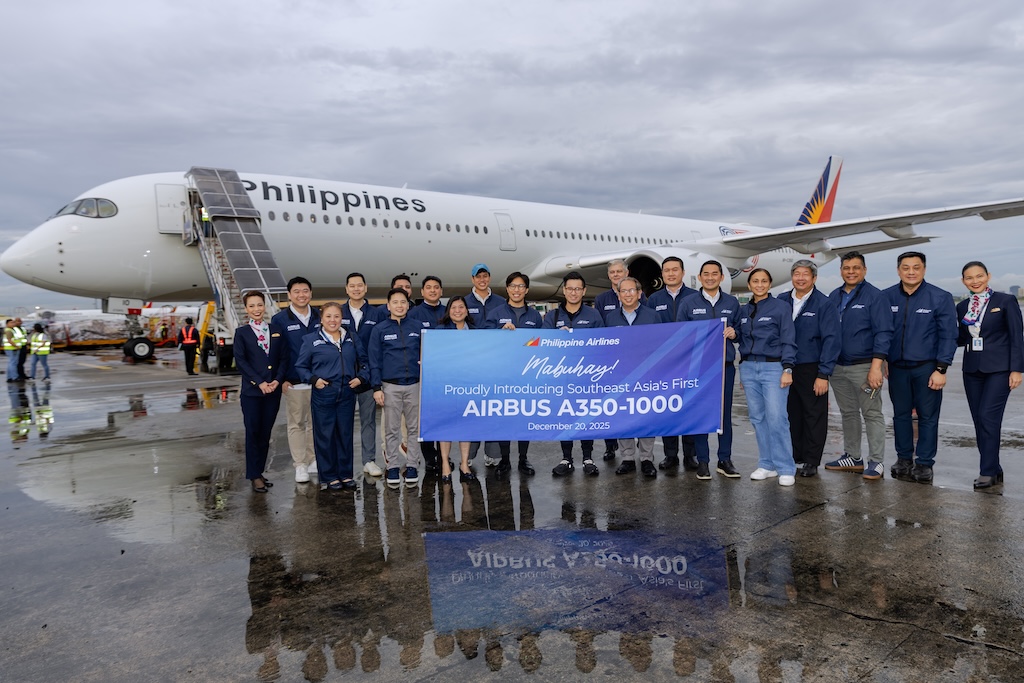
In a milestone moment for aviation in Southeast Asia (SEA), Philippine Airlines (PAL) received yesterday, 20 December 2025, its first Airbus A350‑1000 — the largest and longest‑range variant of Airbus’ next-generation widebody family — marking the first time any airline in the SEA region has operated this aircraft type. This achievement places PAL in a unique position among its regional peers, many of whom operate the smaller A350‑900 but have not yet ordered or committed to the A350‑1000 variant. The arrival of this aircraft signals PAL’s intent to compete on intercontinental ultra‑long-haul routes, especially to North America and potentially beyond.
Among SEA carriers, the Airbus A350‑900 has already been a staple of long‑haul operations for several years. Singapore Airlines (SQ) was among the earliest adopters, placing multiple orders for the A350‑900 and becoming the launch operator of its A350‑900ULR (Ultra Long Range) variant. Their first standard A350‑900 deliveries began in 2016, with the aircraft entering service that same year. Singapore Airlines has since accumulated dozens of A350‑900s, including those tailored for ultra‑long-range operations, serving ultra-long routes such as Singapore–New York.
Vietnam Airlines (VN) took delivery of its first A350‑900 on 30 June 2015, becoming one of the earliest operators of the aircraft in Asia and modernizing its long-haul network. Over subsequent years, the airline received additional A350‑900s, incorporating around 14 aircraft into its fleet. This move allowed Vietnam Airlines to strengthen connectivity between Vietnam and major long-haul destinations.
Philippine Airlines (PAL) entered the A350 era in 2018, with its first A350‑900 delivery on 14 July 2018. PAL originally ordered six A350‑900s to support its long-haul network to Europe, North America, Australia, and Asia, with deliveries occurring between 2018 and the following years. While all three carriers operate the smaller A350‑900, PAL’s recent acquisition of the A350‑1000 breaks new ground in Southeast Asia.
PAL’s order for nine (09) Airbus A350‑1000 aircraft was finalized at the Paris Air Show on 20 June 2023. The aircraft, which boasts extended range and higher capacity, will enable PAL to operate ultra‑long‑haul services — including non-stop flights from Manila to destinations on the East Coast of the United States and Canada, far beyond the reach of many existing aircraft in the region. The first of these jets was delivered this December 2025, officially making PAL the first SEA operator of the A350‑1000. With engines from Rolls-Royce and a design optimized for both capacity and efficiency, the A350‑1000 will be central to PAL’s strategy of connecting the Philippines globally.
While the standard A350‑900 serves many long-haul markets, the A350‑900ULR (Ultra Long Range) — specifically developed for the longest nonstop routes — has seen notable uptake in Asia. Singapore Airlines, for example, has used the A350‑900ULR since 2018 to revive non-stop services between Singapore and destinations like New York and Los Angeles, demonstrating the commercial potential of ultra-long-range operations. Regional airlines are increasingly eyeing these capabilities as global competition intensifies. The ability to conduct non-stop flights between secondary global markets directly — bypassing traditional hubs — has implications for tourism, diaspora travel, and economic linkages across continents.
Understanding PAL’s current strategic positioning requires context on its historic ownership and management. In 2012, San Miguel Corporation (SMC) acquired a 49% stake in PAL, gaining management control with a reported investment of US$500 million. During SMC’s tenure from 2012 to 2014, the airline pursued rapid fleet expansion, including a large order for dozens of Airbus A321s, A330s, and other aircraft. However, the execution of this plan and broader strategic direction led to mixed outcomes.
Under SMC leadership, there were moves to operate PAL more like a low-cost carrier (LCC), which included decisions such as acquiring aircraft with minimal (or no) in-flight entertainment systems (IFEs) and downsizing some service aspects to cut costs. This approach frustrated many long-time PAL supporters, who saw it as a departure from the airline’s identity as the Philippines’ flag carrier and a full-service airline. By 2014, discussions were underway for the Lucio Tan Group to buy back SMC’s stake and regain full management control, ultimately restoring PAL’s strategic direction. Critics argue that the SMC period diluted PAL’s brand and compromised its competitive edge at a time when rival carriers in Asia were investing in service quality and global network leadership.
Today, PAL is retrofitting aircraft acquired during that period — including older narrow-body jets — with better passenger amenities and upgrading service standards, seeking to make up for prior compromises in customer experience.
If PAL had remained under unified and stable leadership that balanced financial discipline with strategic investment in product and service quality — without the distraction of shifting identity under SMC — the airline might have become not just SEA’s premier long-haul carrier but a stronger contender across Asia. With an Airbus A350 fleet spanning both -900 and -1000 variants, PAL now has the hardware to compete head-to-head with airlines of Singapore, Japan, South Korea, and the Middle East on global routes.
Yet history cannot be rewritten. What matters now is how PAL leverages its A350‑1000 fleet to connect the Philippines more directly to the world, narrowing the gap with legacy carriers that have led Asia’s aviation resurgence. In an aviation landscape where connectivity is power, PAL’s bold move with the A350‑1000 is not just about airplanes — it’s about restoring ambition and demonstrating that even after challenging chapters, Southeast Asian carriers can rise to compete on the global stage.