
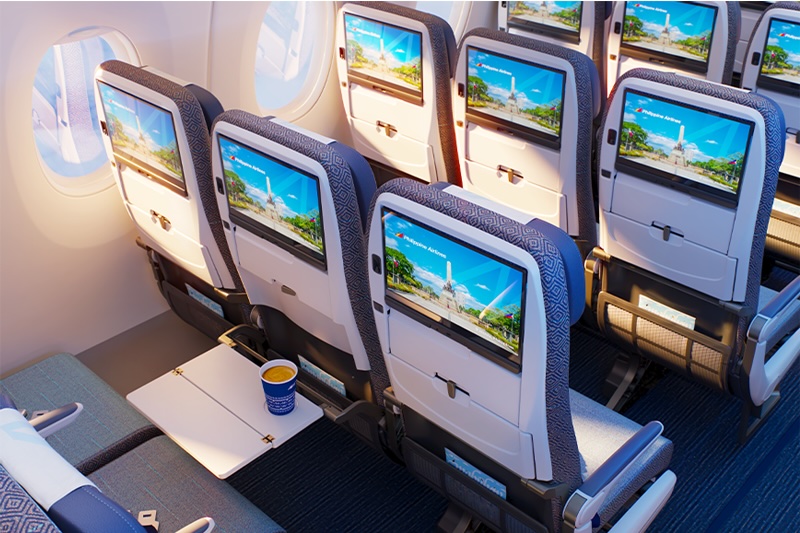
Philippine Airlines’ (PAL) new Airbus A350-1000 is, without question, a technological leap forward for the flag carrier. It is quieter, more fuel-efficient, and capable of flying ultra-long-haul routes nonstop. But beyond the headlines and the prestige of operating Southeast Asia’s first A350-1000, one design choice has sparked intense discussion among AvGeeks and regular passengers alike: PAL’s decision to install a 10-abreast (3-4-3) Economy Class layout with seats measuring about 17 inches wide.
From a purely operational standpoint, the decision is understandable. More seats mean better revenue potential and more flexibility on long routes such as Manila to North America. But from a passenger’s point of view — especially on flights that stretch beyond 12 or even 15 hours — comfort becomes the real battleground.
Slimline Seats: Modern, But Not Magical
PAL’s A350-1000 Economy cabin uses modern slim-profile economy seats, a design now standard across new-generation widebody aircraft. While the term “slimline” is often associated with low-cost, short-haul seating, the seats selected by Philippine Airlines for its long-haul flagship align more closely with today’s definition of high-efficiency, slim-profile seats. Built by a major global aircraft seat manufacturer, these seats utilize lightweight composite materials, thinner but reinforced seatbacks, and carefully sculpted cushions. The objective is clear: reduce overall aircraft weight, improve fuel efficiency, and recover small but meaningful gains in knee space without increasing seat pitch.
These are not the old-school, thickly padded seats of previous generations, nor are they the bare-bones slimline seats commonly found on short-haul low-cost carriers. Instead, they represent a new generation of long-haul-certified slim-profile seating, complete with adjustable headrests and structures designed to withstand extended flight durations while maintaining a clean, modern aesthetic. From a technical standpoint, they are efficient, durable, and well-engineered for long-range operations.
That said, seat width remains a critical factor in overall comfort. No matter how advanced the materials or how well sculpted the cushioning may be, slimmer profiles cannot fully offset the physical reality of reduced shoulder and hip room — especially on ultra-long-haul flights. In the end, technology can enhance comfort at the margins, but it cannot entirely replace the value of personal space.
17 Inches Wide: Where Comfort Becomes Personal
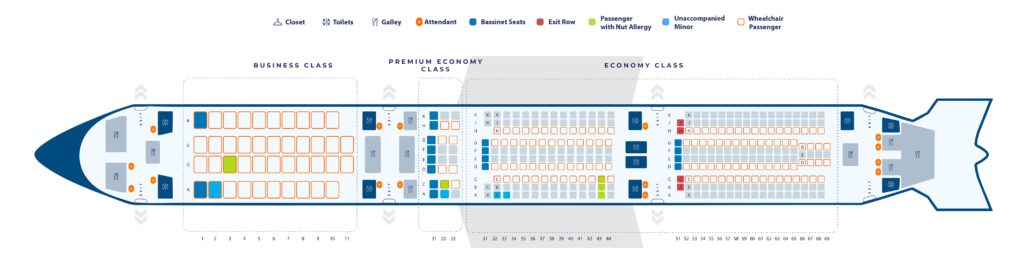
At 17 inches wide, PAL’s Economy seats sit in a gray area. They are wider than the ultra-tight 16–16.5-inch seats used by some leisure airlines like French bee and Air Caraïbes, both of which also fly the A350-1000 in a 10-abreast configuration. However, they are still noticeably narrower than the 18-inch-plus seats found on most full-service carriers that stick to a 9-abreast (3-3-3) layout on the same aircraft.
For many Filipino travelers, this is where the debate gets interesting. Filipinos are, on average, smaller in stature than Western populations, which means a 17-inch seat may feel “acceptable” for a significant portion of passengers, especially on medium-length flights. For shorter travelers with narrower shoulders, the difference between 17 and 18 inches might not immediately feel dramatic.
But on ultra-long-haul flights, comfort compounds over time. Shoulder room, elbow space, and the ability to shift positions become crucial. Even passengers who fit comfortably at boarding may feel constrained several hours into the journey — especially when seatmates inevitably encroach on shared armrests.
How PAL Compares to Other A350-1000 Operators
This is where PAL truly stands out, and not necessarily in a way that everyone will celebrate. Most global A350-1000 operators, including major Middle Eastern, European, and East Asian carriers, have chosen 9-abreast economy seating, prioritizing comfort as part of their premium long-haul brand promise. PAL, by contrast, has aligned its density more closely with leisure-focused airlines, albeit with slightly better seat width.
| Operator | Economy Layout | Seat Width Approx. |
|---|---|---|
| Philippine Airlines | 3‑4‑3 (10‑abreast) | ~17″ |
| Air Caraïbes | 3‑4‑3 (10‑abreast) | ~16.7″ |
| French bee | 3‑4‑3 (10‑abreast) | ~16.7″ |
| Other Flag Carriers | 3‑3‑3 (9‑abreast) | ~18″+ |
In our view, PAL’s A350-1000 Economy product is not uncomfortable — but it is clearly optimized for efficiency, not indulgence. The aircraft itself is world-class; the cabin philosophy is pragmatic. For price-sensitive travelers and for a market where average body size may make 17-inch seats workable, this may be a calculated and defensible choice.
Still, for a flag carrier operating some of the longest flights in the world, the question remains: should the benchmark be “good enough,” or should it be “best possible?” PAL’s new A350-1000 answers that question decisively — and the real verdict will come not from seat maps, but from passengers after 15 hours in the air.
very informative article…will help the passenger decide to which accomodation or class is chosen when buying their ticket. can you feature their premium economy?