
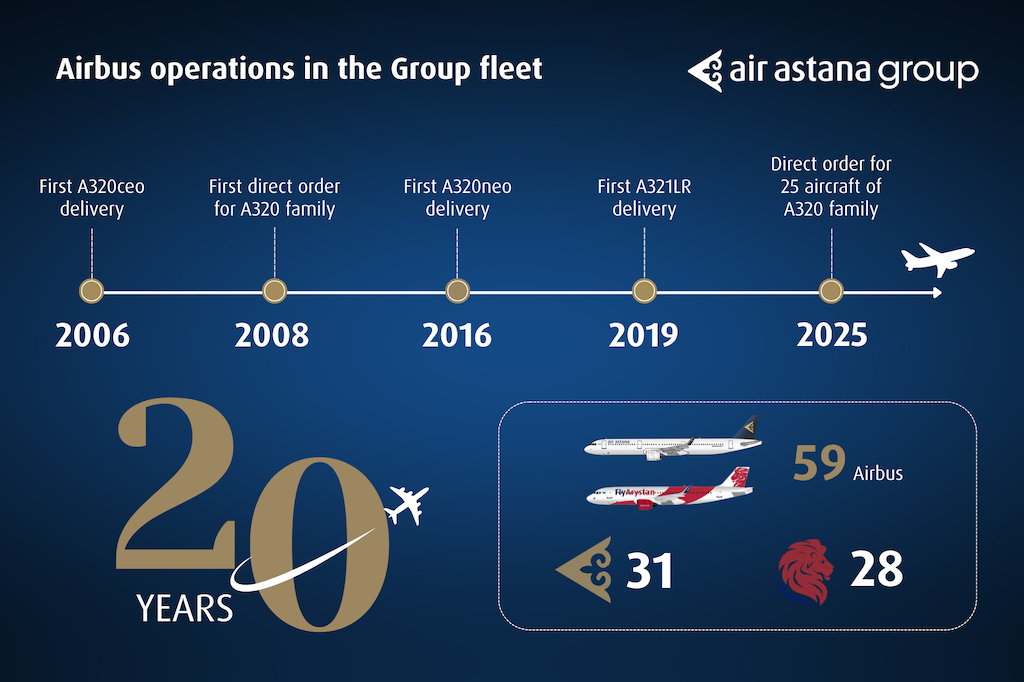
Air Astana (KC) is celebrating a major aviation milestone as it marks two decades of operating aircraft manufactured by Airbus, highlighting a long-term fleet strategy centered on efficiency, modernization, and passenger comfort. The anniversary traces back to February 2006, when the airline took delivery of its first Airbus A320, a move that signaled a strategic shift toward Western-built aircraft and set the stage for sustained expansion.
Since that initial delivery, the carrier’s Airbus fleet has grown dramatically. Today, nearly 60 aircraft are in service across the group, the majority of which belong to the A320 family. Shareholders recently approved the acquisition of 25 additional A320 family jets, reinforcing the airline’s commitment to maintaining a technologically advanced fleet designed to optimize fuel efficiency and operational reliability while improving the onboard experience for travelers.
The airline’s relationship with Airbus deepened in 2008 when it placed its first direct aircraft order with the manufacturer. Deliveries from that purchase arrived in 2012 and 2013, marking a historic moment for the aviation sector in Kazakhstan. The order represented the first time a Kazakhstan-based carrier had directly purchased Airbus aircraft since the country gained independence in 1991, underscoring Air Astana’s role as a pioneer in the nation’s commercial aviation development.
Innovation continued to shape the airline’s fleet strategy in November 2016, when it introduced its first A320neo into service. By adopting the new-generation narrowbody early, Air Astana positioned itself among global carriers embracing improved fuel-burn efficiency and lower emissions. The move also reflected broader industry trends favoring next-generation aircraft capable of reducing operating costs while meeting increasingly strict environmental standards.
Further expansion came in September 2019 with the addition of the airline’s first A321LR. This aircraft type enabled the company to extend its network and operate long-haul routes using narrowbody jets, a capability that has become strategically valuable for airlines seeking flexibility in route planning. One notable example is the nonstop service between Almaty and London, a journey lasting roughly nine hours and considered among the longest narrowbody flights currently in operation worldwide.
At present, the Air Astana Group fleet totals 59 aircraft, consisting of 41 A320/A321neo family jets and 18 A320/A321ceo models. This composition highlights the airline’s gradual transition toward newer-generation aircraft while still leveraging earlier variants to maintain operational flexibility.
The 20-year Airbus milestone reflects more than just fleet numbers. It illustrates how the airline has evolved into a major regional player with a modernized aircraft portfolio capable of supporting network growth across Asia, Europe, and beyond. With additional aircraft on order and a continued focus on efficiency and passenger satisfaction, Air Astana appears poised to build on its Airbus partnership as it enters its next phase of expansion.