
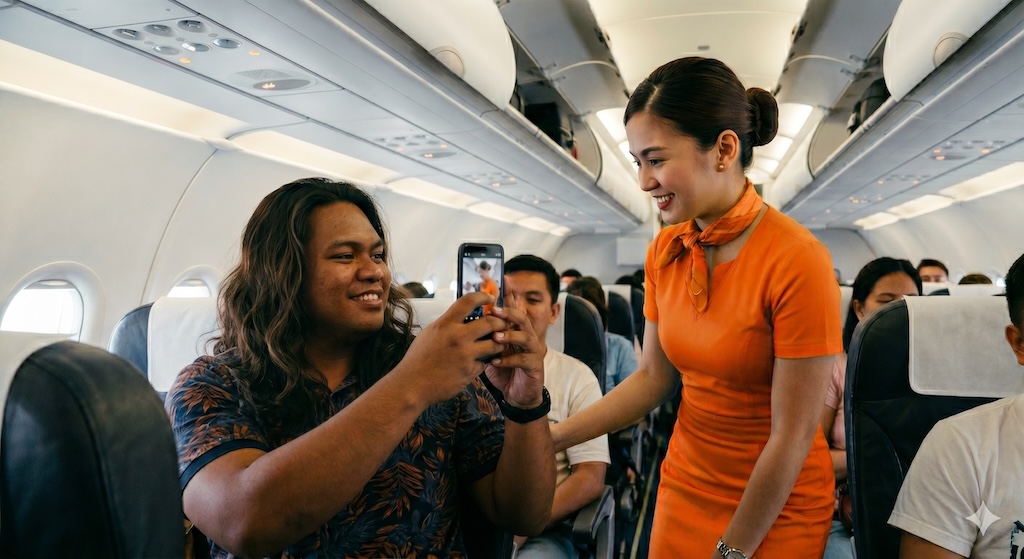
In the age of viral “shaming” videos and social media call-outs, someone is demanding that local airlines impose strict bans on filming flight attendants and ground crew. While the desire to protect employees from online vitriol is well-intentioned, a blanket prohibition on photography ignores the cultural reality of the Filipino traveler and creates a complex legal gray area regarding privacy and consumer rights.
The “First Flight” Milestone: A Cultural Context
To understand why Filipinos are so fond of taking photos onboard, one must look at the socio-economic landscape of the Philippines. For a significant portion of the population, air travel is a hard-earned luxury — a symbol of success after years of saving or the beginning of a life-changing journey as an OFW.
When a Filipino traveler takes a photo of the cabin or the crew, it is rarely with “malicious intent.” It is a documentation of a milestone. In the Filipino “Bida” culture, sharing these moments with family and friends is a way of bringing them along on the journey. Turning a smartphone into a “prohibited item” risks criminalizing the joy of first-time travelers who are simply capturing a memory they may not get to experience again for years.
Navigating the Data Privacy Act (RA 10173)
The argument for a ban often cites the Data Privacy Act (DPA), but the law is more nuanced than many realize. The DPA is designed to protect personal information from unauthorized processing, but it is not a “shield” that prevents someone from being photographed in a public-facing professional capacity.
An aircraft is a unique space — it is a privately-owned environment operating as a public utility. When crew members perform their duties, they are acting as representatives of a public service. While airlines can implement “House Rules” to maintain order, the act of taking a photo of a service interaction is generally not a violation of the DPA, provided the data is not being processed for criminal purposes.
The Legal Distinction: Recording vs. Publishing
The most critical point of the debate is the distinction between taking a photo and posting it publicly with malice.
- Recording for Evidence:
Passengers often record interactions as a form of “insurance.” In a situation where a passenger feels mistreated, a video serves as an objective “receipt.” Removing the right to record creates a power imbalance where the passenger has no evidence if they choose to file a formal complaint later. - Cyber Libel:
If a passenger posts a photo with the intent to harass, shame, or spread falsehoods, they are already subject to the Cybercrime Prevention Act of 2012. We do not need new airline regulations to punish online shaming; the legal framework for “Cyber Libel” already exists to handle those who use their platforms to damage reputations.
Why “Strict Prohibitions” Might Backfire
The suggestion to “offload or arrest” passengers for filming is a disproportionate response. Such policies could lead to unnecessary confrontations and even “power tripping” on either side, further damaging the relationship between the airline and its customers.
Instead of imposing rigid bans, the industry should focus on Digital Literacy. Educating the public on the ethical use of social media and the consequences of defamation is a far more effective — and human — approach than threatening a first-time traveler with airport police for wanting to remember their flight.
In the end, the sky should be a place of respect, but that respect must go both ways. Protecting the privacy of the crew is important, but it should not come at the cost of transparency and the personal memories of the flying public.
DISCLAIMER: The photo used in this content is AI-generated and created for illustrative purposes only. Any resemblance to real persons, living or deceased, is purely coincidental and not intended.