
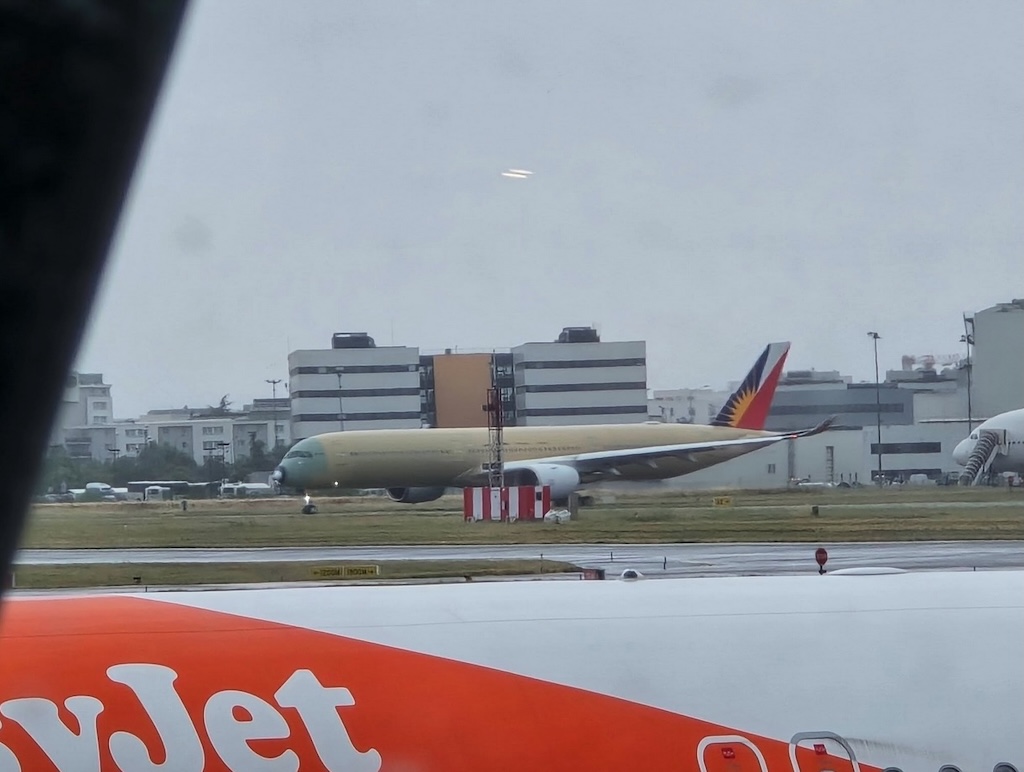
To aviation enthusiasts and plane spotters, the final assembly lines in Toulouse and Hamburg are a constant source of fascination. Recently, a peculiar sight caught the eye of onlookers, as captured in the image above: a brand-new Airbus A350-1000 (F-WZHC | MSN 792) destined for Philippine Airlines (PAL) taking to the skies for a test flight while still completely covered in its greenish-yellowish (somewhat beige) primer.
What makes this situation particularly intriguing is that another PAL A350-1000 with a lower Manufacturer Serial Number (MSN) — meaning it was technically built earlier in the production sequence — was sitting on the ground fully painted in PAL’s iconic livery, yet it had not yet taken its first flight.
Why would Airbus fly a plane that is seemingly “less finished” ahead of one that looks ready to go? The answer lies in the highly strategic, non-linear world of modern aircraft manufacturing, cabin customization, and scheduling optimization.
The Paint Shop Bottleneck and Hangar Scheduling
Aircraft final assembly lines (FAL) operate like a highly synchronized orchestra, but the paint shop is a distinct, resource-intensive station. Applying an airline livery involves meticulous layer application, curing times, and rigorous customer acceptance inspections.
Because paint slots are tightly booked, Airbus frequently shuffles the order in which aircraft visit the paint hangar. If the lower-MSN aircraft secured an early slot in the paint hangar, it would receive its livery first. However, being painted does not mean its mechanical or electronic systems are fully cleared for flight. Conversely, the higher-MSN aircraft in the primer paint likely missed or bypassed an immediate paint slot, allowing Airbus engineers to advance their schedule by conducting early “primer flights” instead of letting the airframe sit idle.
Cabin Interior Installation Delays
The single biggest variable in modern widebody manufacturing is not the exterior, but the interior. Philippine Airlines (PAL) configures its flagship A350-1000s with a luxurious three-class layout, featuring bespoke business class suites with privacy doors, custom premium economy seats, and complex in-flight entertainment (IFE) architectures. Supply chain delays for specific cabin components — such as a shortage of custom seat mechanisms or galley units — can completely halt the completion of an aircraft’s interior.
The fully painted aircraft may have its exterior completed but is likely waiting on these delayed interior cabin components. Because it isn’t internally complete or weighted correctly, it cannot yet perform its first test flight. On the other hand, the primer aircraft likely had all of its interior components arrive right on time. With a fully weighted, completed cabin, it is ready to undergo technical and aerodynamic flight testing immediately, regardless of its unpainted exterior.
Structural Testing versus Customer Acceptance Flows
Airbus splits its flight testing into two major phases to keep the production line moving efficiently. The first flight, often referred to as the production or chalice flight, tests the basic airframe aerodynamics, engines, and core flight controls. This flight can be performed safely while the composite structure is covered in its protective beige anti-corrosive primer barrier.
Customer acceptance flights happen much later in the process and require the aircraft to be in its final aesthetic form. By flying the higher-MSN aircraft in its primer, Airbus can validate the airframe’s mechanical integrity early. Once it passes these essential checks, it will be sent to the paint shop. This parallel processing ensures that a delay on one aircraft’s interior doesn’t grind the entire assembly line’s testing schedule to a halt.
When tracking line numbers and MSNs, it is natural to assume production follows a strict numerical order. However, as this Philippine Airlines (PAL) case demonstrates, an aircraft’s readiness to fly is dictated by its internal maturity and testing schedule, while its livery is simply a matter of hangar real estate and scheduling convenience.