
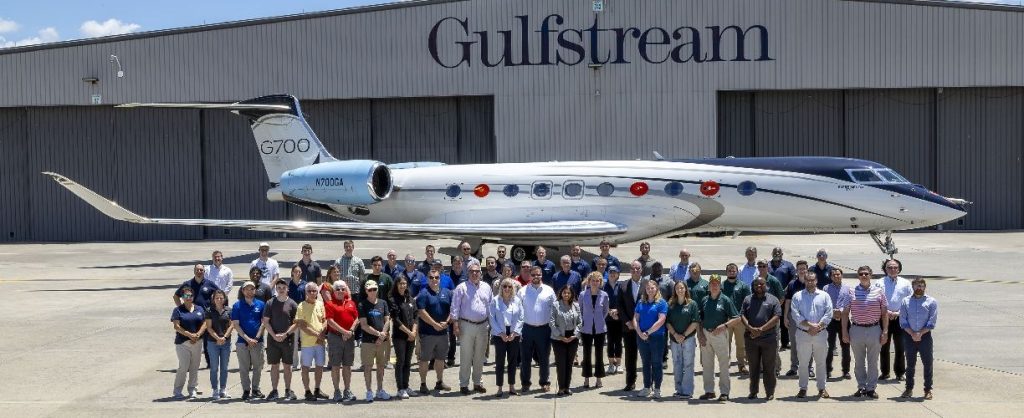
Rolls-Royce has achieved another significant milestone in sustainable aviation as its Pearl 700 engines successfully powered the inaugural flight of the Gulfstream G800 using 100% Sustainable Aviation Fuel (SAF). This historic flight was executed as part of Gulfstream Aerospace’s high-altitude flight test campaign. The primary mission of the initiative was to demonstrate the immense potential of 100% neat Sustainable Aviation Fuel to significantly reduce contrail-forming particle emissions, particularly at cruising altitudes reaching up to 50,000 feet.
To capture the critical data, the Gulfstream G800 aircraft was paired with a specially modified Gulfstream G700. This companion aircraft was also powered by the same Pearl 700 engines and was effectively transformed into a flying emissions measurement laboratory for the mission. Operating in a tight, close formation, the dual-aircraft setup enabled researchers to capture highly precise, real-world measurements of particulate matter alongside contrail-forming atmospheric characteristics. These measurements were taken at higher altitudes than those typically flown by most commercial airliners, which represents the standard operating environment for modern business aviation.
The pioneering campaign was led by Gulfstream Aerospace and conducted in close collaboration with a powerful coalition of industry and scientific leaders. This group included the Federal Aviation Administration, NASA, the German Aerospace Center, Missouri University of Science and Technology, Rolls-Royce, Aerodyne Research, Montana Renewables, and World Fuel Services. The collaborative campaign was deliberately designed to isolate exactly how different fuel compositions influence non-carbon dioxide emissions, which is an area of rapidly increasing focus across both the scientific community and the global aerospace industry.
To accomplish these rigorous analytical goals, the research team directly compared conventional Jet-A aviation fuel, low-sulfur Jet-A, and neat Hydro-processed Esters and Fatty Acids Sustainable Aviation Fuel, which notably contains no sulfur or aromatics. Preliminary results from the flight tests suggest a highly significant and measurable reduction in the particulate emissions that directly contribute to contrail formation when the aircraft is operating entirely on neat Sustainable Aviation Fuel.
Alan Newby, the Director of Research and Technology at Rolls-Royce, noted that sustainable aviation fuels, when combined with compatible and ultra-efficient aero engines, will play a vital role in de-carbonizing aviation while simultaneously reducing certain non-carbon dioxide emissions. He emphasized that the valuable insights gained from these latest high-altitude tests, alongside historical data from projects like QRITOS or ECLIF3, are driving tangible progress in understanding the climate impacts of non-carbon dioxide emissions and uncovering potential mitigation options.
This successful campaign clearly demonstrates how Gulfstream and Rolls-Royce are completely aligned in advancing environmental performance across the broader aerospace industry. The newly acquired data will be utilized in close partnership with the wider aviation and atmospheric science communities to refine analytical models, inform future global fuel standards, and support the development of practical operational strategies to reduce the overall environmental footprint of air travel.
The tests proved once again that all of Rolls-Royce’s in-production Trent and business aviation engines can operate seamlessly with 100% Sustainable Aviation Fuel, effectively laying the foundational groundwork for moving this type of eco-friendly fuel toward full regulatory certification. At present, Sustainable Aviation Fuel is only legally certified for commercial blends of up to 50% when mixed with conventional jet fuel. However, Sustainable Aviation Fuel maintains the ultimate potential to reduce net lifecycle carbon dioxide emissions by about 80% compared to traditional jet fuel, marking a massive leap forward for the industry.