
For many Filipinos embarking on international journeys, clearing border control at domestic airports remains one of the most taxing phases of travel. Even when travelers possess legitimate passports, confirmed return tickets, and comprehensive travel documentation, departing citizens routinely face inquiries concerning their employment status, financial capacity, travel companions, and itinerary details. Recent discussions regarding the elimination of routine face-to-face departure interviews have reignited a fundamental question: can Philippine international gateways eventually transition away from mandatory in-person questioning?
From a technological and operational perspective, the capability to automate departure border processing already exists. The Philippines has already introduced essential infrastructure required for modern border clearance, yet completely ending standard interviews will demand substantial reforms beyond simply adding electronic gates. A comprehensive transition requires updates to existing statutory frameworks, regulatory procedures, inter-agency data sharing, and passenger vetting mechanisms.
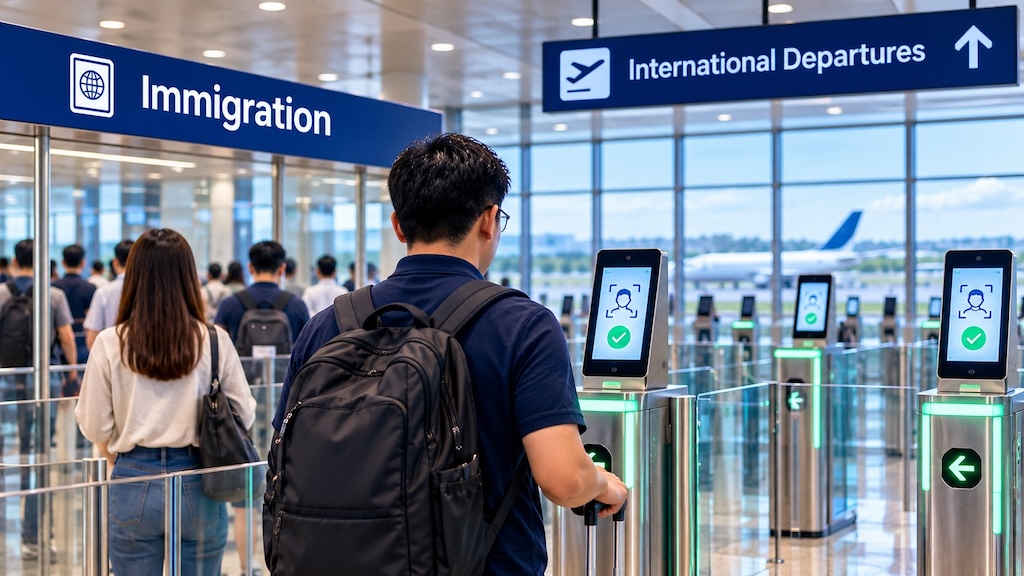
A vital distinction in modern aviation border management is that eliminating in-person interviews does not equate to dismantling departure controls. Sovereign nations routinely maintain rigorous border supervision without subjecting every passenger to a spoken interview. Automated border control systems, commonly known as e-gates, verify eligible travelers at major global airports using electronic passport reading, biometric authentication, and automated database lookups. Instead of presenting documents directly to an officer seated at a booth, travelers scan their passports, submit to biometric matching, and proceed as soon as the system confirms eligibility, with non-qualifying or flagged travelers redirected to manual counters.
The Bureau of Immigration (BI) has actively deployed automated border technologies under its ongoing modernization programs. In May 2026, the bureau initiated testing of 18 additional electronic gates at Ninoy Aquino International Airport (NAIA) Terminal 3, expanding the terminal’s total installation to 60 units. While this initial rollout accommodated qualified arriving citizens and departing overseas Filipino workers on airlines participating in advance data protocols, regular Filipino tourists were not initially included. In addition, through its Advance Passenger Information System, the bureau connected 49 airlines by September 2026, encompassing roughly 99% of international flight operations in the country. Bureau data indicates that automated gate clearances typically take between 5 and 15 seconds under normal conditions, establishing a solid operational foundation for broader clearance automation.
Realizing an interview-free departure protocol for the broader traveling public requires concrete administrative and policy changes. The government must first overhaul existing departure screening criteria to define specific eligibility thresholds and clear grounds for officer intervention. Automated clearance must subsequently be widened to include regular tourists, business travelers, and other groups across high-volume departure hubs like NAIA, Clark, and Mactan-Cebu. Crucially, immigration systems require direct, real-time connectivity to government databases containing court-ordered hold departures, watchlists, and passport status records, shifting passenger evaluation to advance intelligence rather than spontaneous counter questioning. Referrals to secondary inspection would then be restricted to documented discrepancies, travel bans, or credible risk indicators.
The primary hurdle to this transition lies in the country’s mandate to combat human trafficking and illegal recruitment. Under Republic Act No. 9208 and inter-agency coordination led by the Inter-Agency Council Against Trafficking under the Department of Justice, departure checkpoints serve as a primary defense line. The bureau noted in October 2026 that strict border vetting continues to target human trafficking risks. Because modern automated gates cannot recognize subtle behavioral signs of coercion or exploitation among travelers carrying legitimate travel credentials, border security must adopt stronger intelligence gathering, advanced profile screening, and multi-agency coordination to protect vulnerable individuals without inconveniencing millions of legitimate travelers.
From a legal standpoint, the Philippine Constitution protects the right to travel under Article III, Section 6, providing for limitations only based on national security, public safety, or public health as determined by law. There is no constitutional rule requiring an in-person interview for every departing citizen. However, because border policies intersect with anti-trafficking statutes, any modification involves coordinated action across executive bodies. The Department of Transportation (DOTr) cannot unilaterally implement these policy changes; authority over immigration inspection rests with the Bureau of Immigration under the Department of Justice (DOJ), requiring synchronized efforts among transport regulators, justice officials, anti-trafficking bodies, and terminal operators.
Ultimately, replacing manual interviews with automated processing could resolve substantial terminal congestion, particularly during international departure banks when multiple widebody flights depart simultaneously. By expediting the flow of verified, low-risk passengers, officers can focus their attention on complex verifications while reducing flight-delay risks. Transforming departure border clearance from an arbitrary questioning session into an efficient, predictable administrative process will ultimately depend on whether policymakers are ready to balance robust border protection with modern, intelligence-driven traveler facilitation.