
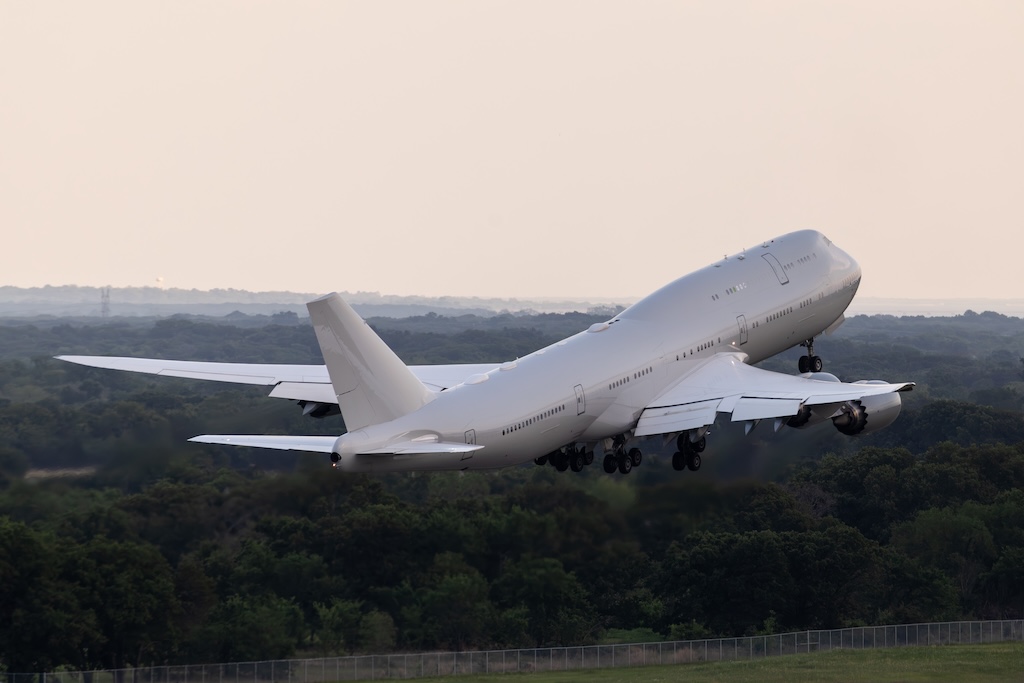
The “Flying Oval Office” is getting a much-needed reinforcement. In a move that highlights both the urgency of presidential transport and a masterclass in creative acquisition, the U.S. Air Force (USAF) has announced that the VC-25B Bridge aircraft has officially completed its modification and flight testing phases. Now entering the paint shop, the aircraft is slated to debut its new red, white, and blue livery this summer, marking a pivotal moment for the presidential airlift mission.
The VC-25B Bridge program isn’t just about adding another B747 to the fleet; it represents a fundamental shift in Air Force procurement strategy. By utilizing a streamlined portfolio management construct, authorities were aligned with direct operational control. This allowed the enterprise to bypass traditional bureaucratic bottlenecks and deliver results with exceptional speed.
According to Gen. Dale White, Department of War direct reporting portfolio manager for Critical Major Weapon Systems, this program serves as a prime example of what happens when clear accountability is placed on a single individual and stakeholders align behind a solitary mission: relieving the pressure on the aging and increasingly maintenance-heavy VC-25A fleet.
The Road to the Bridge
The necessity for an interim solution became clear as the primary Boeing VC-25B program (the direct replacement for Air Force One) faced delays beyond its initial 2024 target. With the current VC-25A airframes requiring longer heavy maintenance cycles, the Air Force launched a full-scale effort in February 2025 to secure a “bridge” capability while simultaneously pushing Boeing to accelerate the long-term production of the final VC-25B fleet.
By strictly defining baseline requirements and maintaining a “laser focus” on core security and communication needs, the team managed to avoid the “requirement creep” that often plagues large military projects. Remarkably, this disciplined approach helped pull the estimated delivery of the permanent Boeing VC-25Bs forward by a full year, with the updated schedule now targeting 2028.
Global Sourcing and Technical Benchmarks
To meet this aggressive timeline, the Air Force looked globally, eventually securing a head-of-state-configured Boeing B747-8i from Qatar. This aircraft serves as the primary bridge airframe. The modification process was handled by L3Harris, leveraging their expertise in executive communication systems and self-protection suites.
| Aircraft Source / Type | Role in VC-25B Program |
| Former Qatar Head of State 747-8i | The primary airframe will be used as a bridge until the VC-25B is ready. |
| Atlas Air 747-8F (Lease) | Facilitated interim pilot qualification training (Oct 2025 – Feb 2026). |
| Former Lufthansa 747-8i (#1) | Dedicated trainer for aircrew and maintainers to ensure readiness. |
| Former Lufthansa 747-8i (#2) | Integrated into an organic parts pool for long-term sustainment. |
Beyond the hardware, this program set a new gold standard for security. Elite specialists developed advanced protocols to scan and neutralize technical hazards on these previously owned aircraft, effectively creating a new manual for integrating used commercial airframes into the high-security military inventory.
Preparing for the Next 40 Years
The Bridge program is about more than just a temporary fix. Secretary of the Air Force Troy Meink noted that by integrating the B747-8i platform now, the Air Force is maturing its training pipelines and synchronizing supply chains years ahead of schedule.
From constructing at-scale mockups for White House staff to establishing a parts pool from former Lufthansa airframes, the Air Force is building a sustainable ecosystem. This ensures that the presidential fleet remains mission-ready not just for today, but for the next three to four decades. As the “Bridge” prepares for its summer rollout, it stands as a testament to aviation innovation and the “no-fail” mission of the U.S. Air Force.