
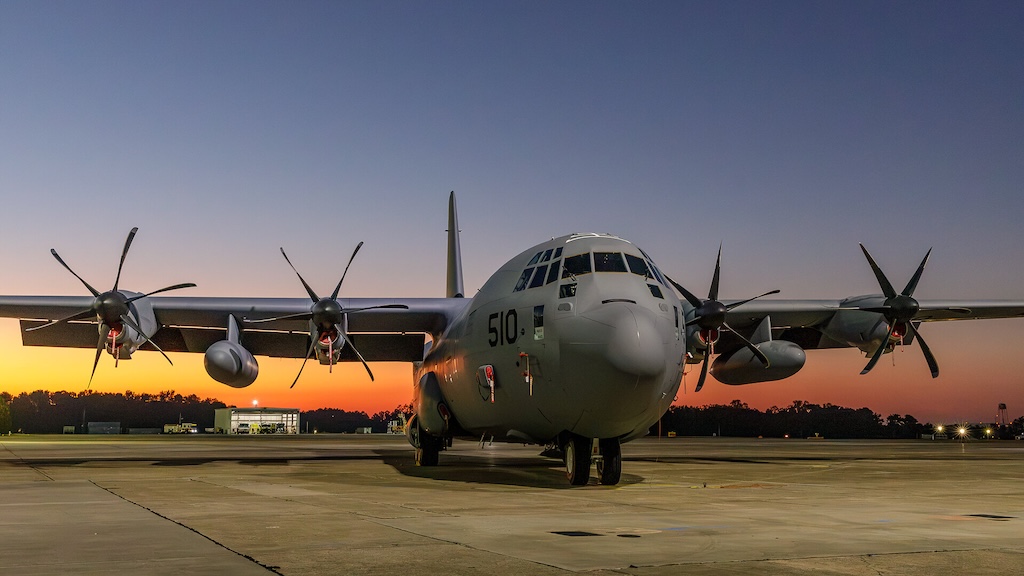
A new era in strategic airborne command and control capability has officially commenced for the United States Navy following Lockheed Martin’s delivery of a C-130J-30 Super Hercules aircraft at its Marietta, Georgia, facility on 15 October 2026. The delivery marks a major turning point for national defense infrastructure, as the newly received aircraft is destined to serve as the structural backbone for the future of the Navy’s critical Take Charge and Move Out (TACAMO) mission. Under the designation of the E-130J Phoenix II, this platform will fulfill an expanded operational role for the versatile Super Hercules family while securing the strategic communications network required by defense forces.
The Take Charge and Move Out mission represents the U.S. Navy’s dedicated airborne nuclear command-and-control support operation, a role that demands absolute operational integrity, survivability, and continuous long-endurance flight capability. In selecting the C-130J-30 Super Hercules for this critical duty, the Navy gains access to a domestically produced, reliable, long-endurance, four-engine platform that brings a long record of proven performance to the assignment. The C-130J-30 variant provides distinct technical and physical advantages that align with the rigorous parameters of the mission, including advanced avionics systems, increased power generation, extended operational range, enhanced fuel efficiency, and a significantly higher payload capacity. Together, these modernized capabilities deliver the exact endurance and operational strength that the national airborne nuclear command-and-control network demands.
Highlighting the scope of the achievement during the delivery ceremony, Trish Pagan, vice president of Lockheed Martin’s Air Mobility & Maritime Missions, reflected on the historical weight and technical evolution represented by the platform. “This delivery marks a historic milestone for the U.S. Navy, Lockheed Martin, and the nation’s strategic communications network,” Pagan stated. “The C-130J-30 Super Hercules continues to evolve and adapt to the needs of our customers, carrying the proven reliability of its lineage while transforming into a new, strategic mission set. It is built to deliver the capabilities our joint force demands and built to last through any operational challenge.”
This milestone delivery re-establishes a significant historical connection between the Take Charge and Move Out operational framework and the wider Hercules airframe family. For a thirty-year period spanning from 1963 until 1993, the EC-130Q variant served as the U.S. Navy’s primary operational Take Charge and Move Out platform, successfully carrying out strategic communications duties across decades of global operations. The introduction of the new Super Hercules builds directly upon that formidable historical legacy while incorporating contemporary operational technologies, including modern avionics, specialized communications suites, and crucial survivability enhancements designed to meet modern security environments.
Expressing confidence in the newly delivered airframe and its future operational transition, U.S. Navy Capt. Roger Davis, Airborne Strategic Command, Control and Communications program manager (PMA-271), emphasized the structural readiness of the aircraft. “The C-130J platform has a storied history supporting our strategic communications mission, and accepting this first C-130J-30 marks an exciting new chapter,” Capt. Davis explained. “Lockheed Martin’s delivery of this battle-proven airframe provides the structural and performance backbone our mission requires as we transition into mission systems integration to field the E-130J Phoenix II.”
Following this initial delivery from Lockheed Martin, the operational transformation of the aircraft will proceed to its next major phase. The Super Hercules airframe will be transferred directly to Northrop Grumman, which serves as the primary mission systems integrator for the project. Working alongside the broader Take Charge and Move Out industry team, Northrop Grumman will complete the intensive mission systems integration and conversion process required to equip the aircraft for full strategic service. Once these specialized systems are installed and thoroughly integrated into the airframe, the aircraft will formally enter operational military service under its designated platform name, the E-130J Phoenix II, safeguarding national command links for years to come.