
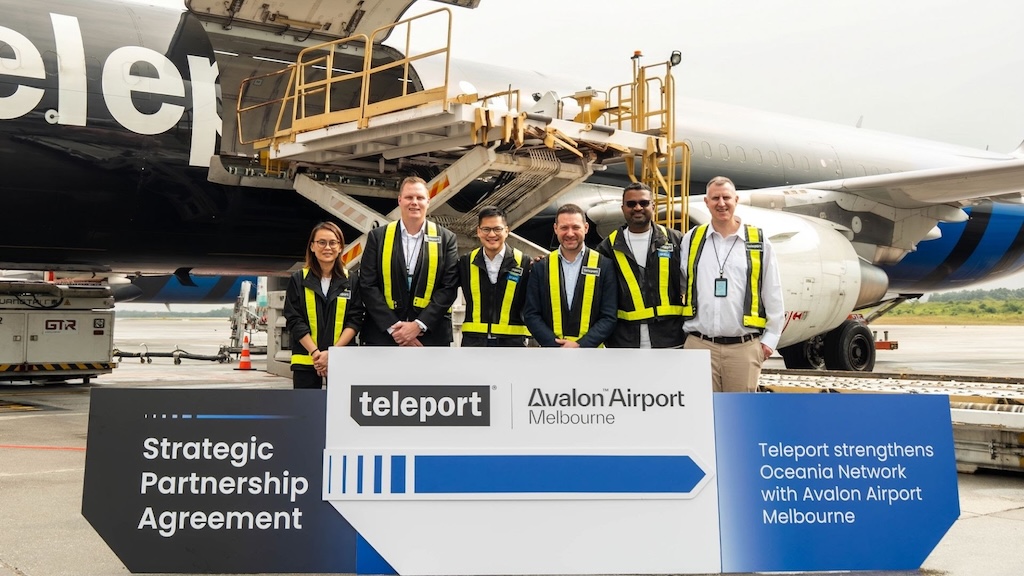
The strength of the overall Teleport Network® lies in the seamless integration of all its moving parts working together as a unified system, including airlines, airports, strategically positioned hubs, capacity, and market demand. This week, the company added another crucial piece to its expanding regional footprint by hosting Ari Suss, Chief Executive Officer of Avalon Airport Melbourne, alongside his team in Kuala Lumpur (KUL). Prior to officially putting pen to paper to sign their strategic partnership, the host team took the visiting executives behind the scenes of their active eCommerce hub and dedicated freighter operations. This landmark collaboration will officially establish Avalon Airport Melbourne as Teleport’s latest strategic operations hub in Australia, further strengthening vital air cargo connectivity between Asia and Oceania.
While traditional airline partnerships provide raw cargo capacity, choosing the right airport partners enables the company to maximize that capacity far more effectively. Part of this strategy involves looking beyond traditional cargo hubs toward an innovative secondary airport model, which connects existing infrastructure and passenger capacity directly to growing cargo demand. The practical success of this approach has already been demonstrated in other major regional markets. For instance, in 2025, cargo throughput at Thailand’s Don Mueang grew 89% year-over-year, while cargo volume at Phuket expanded more than four times over the same period.
Although Australia is already an active part of the Teleport Network®, with substantial freight moving consistently into major metropolitan centers including Melbourne, Sydney, Brisbane, and Perth from destinations across Asia, Avalon Airport Melbourne brings an exceptionally flexible gateway into the mix. The facility’s dedicated freight infrastructure, available operational capacity, and curfew-free operations make it particularly well suited to accommodate the high speed and inherent variability of cross-border eCommerce logistics. This operational flexibility comes at a vital time, as Australian marketplace eCommerce spend reached nearly AUD19 billion in 2025, representing a 13% increase year-over-year. Under this new arrangement, Teleport brings the underlying cargo demand and extensive network reach, while Avalon Airport Melbourne provides the physical gateway and operational capability, giving air cargo more efficient ways to move throughout Asia and Oceania.
Highlighting the long-term potential of the strategic collaboration, Pete C., Chief Executive Officer, detailed how both organizations share a unified vision for regional logistics expansion:
“We see an opportunity to bring more freighter capacity, connect more airlines into Avalon Airport, and build an end-to-end network that benefits the wider Victorian market. What really makes this partnership work is that we share the same principles. Ari talks about bringing costs down for Australian consumers, and that resonates strongly with us. That’s how we’ve built Teleport – using our network and partnerships to make logistics faster, better and more affordable.
From our first conversation, we shared the same ambition: to build a network that can support substantial imports into Victoria while also unlocking more export opportunities from the state. We’ve done this successfully through alternative and secondary hubs in our network, and we see the same potential at Avalon Airport.
What stood out to me when I first visited Avalon Airport was the investment they’ve made in a purpose-built cargo facility. Having toured it earlier this year, it was clear to me that Ari and his team were thinking about the long term. That’s important to us when we make strategic decisions about our network.
We’re committed to building this for the long term, alongside Avalon Airport, our airline partners and customers. For us, this is about finding the right partner and building something together that lasts.”