
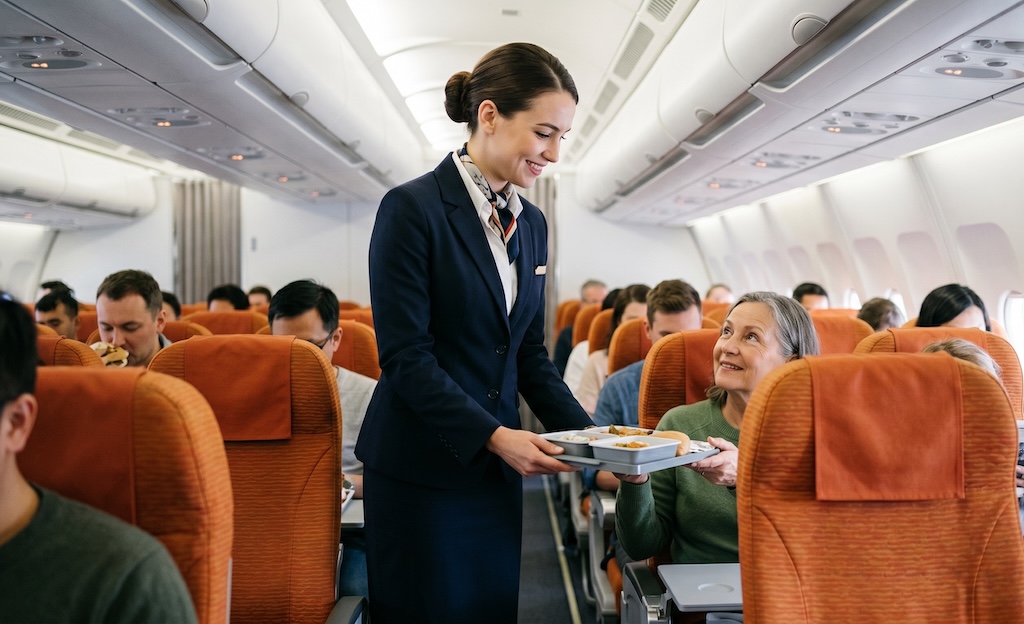
NOTE: The image above is AI-generated for illustration purposes. We utilize AI-generated visuals to avoid using unpermitted photos of actual airline cabin crew and to respect their privacy and workflow. Cabin crews have vital safety duties and operational functions onboard, and we believe in letting them perform their jobs without the distraction or disturbance of a camera lens.
If you’ve flown domestic Economy on Philippine Airlines (PAL) recently, you’ve probably noticed the catering routine. The seatbelt sign dings, the crew rolls out the cart, and you’re handed a cup of water, tea, or coffee paired with a pre-packaged cookie or a small bag of mixed nuts. For some Gen Z travelers, this is just normal. But for the veteran flyers among us, it begs the nostalgic question: When did our flag carrier stop serving full, hot meals on local flights?
Let’s dive into the history, the economics, and why this isn’t just a PAL thing — it’s a global aviation reality.
The Timeline: From Hot Plates to Foil Pouches
The death of the domestic full meal didn’t happen overnight. It was a gradual descent that started nearly three decades ago, with the initial turning point arriving in the late 1990s. Up until the mid-90s, it wasn’t uncommon to get a heavy, hot meal tray on a flight from Manila (MNL) to Cebu (CEB) or Davao (DVO). However, the 1997 Asian Financial Crisis hit PAL incredibly hard, culminating in a devastating labor strike and a temporary shutdown in 1998. During the subsequent financial restructuring, PAL cut the hot meals in domestic Economy, replacing them with fresh, complimentary bakery items like a warm asado bun or a sweet pastry.
The service saw further instability during the 2011 disruptions. In October of that year, PAL faced severe operational hiccups during an outsourcing transition of its catering and ground services. While hot meals were temporarily impacted across the entire network, the baseline for the domestic economy remained firmly anchored to these light snacks once the dust settled.
The final evolution happened during the 2020 pandemic. To minimize physical contact between crew and passengers, and to preserve cash during the worst downturn in aviation history, PAL stopped serving fresh sandwiches and buns. They pivoted instead to sealed, pre-packaged dry snacks like cookies or crackers. Today, if you want a hot wrap or a more substantial snack on a domestic flight, you have to book Comfort Class or Business Class, as full, multi-course hot meals are now strictly reserved for international routes.
It’s Not Just Because of Low-Cost Carriers
The knee-jerk reaction for most Filipinos is to blame the rise of Low-Cost Carriers (LCCs) like AirAsia and Cebu Pacific. While it’s true that LCCs forced Full-Service Carriers (FSCs) to adapt, the death of the short-haul meal is driven by a much colder mathematical equation focused on turnaround times and aircraft utilization. Airlines don’t make money when their planes are sitting on the tarmac. To maximize profit, a single Airbus A321 might fly six to eight domestic sectors a day, making ground efficiency absolutely paramount.
This creates a logistics nightmare when hot food is involved. Cleaning up nearly two hundred hot meal trays, unloading heavy catering trucks, and reloading fresh ovens takes up precious time that airlines cannot afford to waste on the ground.
In addition, there is a heavy-weight penalty associated with full service. Carrying heavy convection ovens, metal meal carts, and hundreds of liters of water burns significantly more fuel, driving up operational costs.
The short cruise window on domestic routes makes traditional service impractical. On a 50-minute flight from Manila (MNL) to Iloilo (ILO), the aircraft is only at cruising altitude for about 15 to 20 minutes. It is physically impossible for a cabin crew to safely distribute 180 hot meal trays and collect them before the captain commands the crew to prepare for landing. By switching to a cookie or a light snack, PAL radically speeds up its turnaround times, slashes fuel burn, and ensures the cabin crew can actually finish service without rushing.
A Global Phenomenon: The Short-Haul Snack Rule
If you think PAL is being stingy, look around the world. Full-service airlines globally have applied this exact same concept to short-haul routes for years. In the United States, legacy carriers like Delta, United, and American Airlines will only give you a Biscoff cookie or a small bag of pretzels on domestic flights, even if you’re flying for two or three hours. In Europe, British Airways and Lufthansa have gone a step further, completely eliminating free snacks in short-haul Economy and converting instead to a “Buy on Board” model where you have to pay out of pocket for food.
Perhaps the most famous regional example of this close to home is Cathay Pacific (CX). Historically known as one of the world’s premier 5-star airlines, Cathay Pacific permanently altered its service on the ultra-short Hong Kong to Manila (HKG-MNL) route following the industry downturn after 11 September 2001. Because the flight time is barely close to two hours, Cathay eliminated the traditional hot tray service in Economy for this sector. For decades, regular flyers on the MNL-HKG route have known that instead of a hot chicken-and-rice dish, Economy passengers are handed a specialized, hot snack box containing a savory sandwich or a pastry, a cookie, and a juice box. It is a highly optimized service designed specifically to beat the clock on short, high-density regional routes.
The Takeaway
So, the next time you unwrap that complimentary cookie on your PAL flight to Boracay (MPH), don’t view it as a downgrade. View it as a symptom of modern commercial aviation efficiency. In the 1980s, flying was a luxury where you paid a fortune and got a hot meal. Today, aviation is mass transit — we pay less in relative terms, fly on safer, more efficient planes, and eat our heavy meals at the terminal before we board.
Clear skies, everyone! Turn on your flight mode and enjoy the ride.