
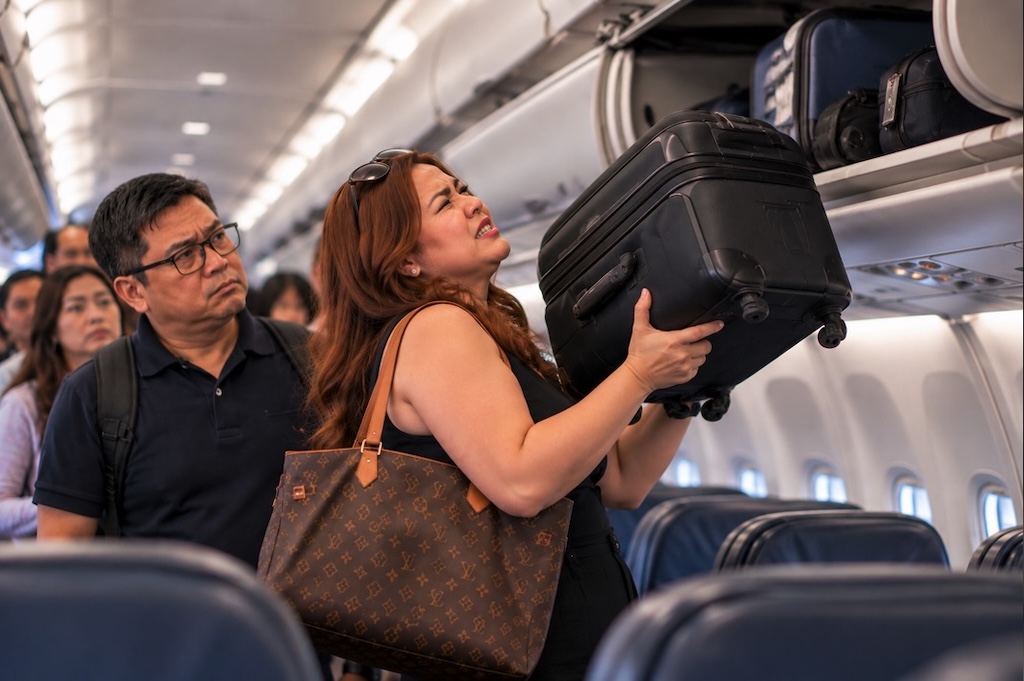
Helping another passenger lift heavy luggage into an aircraft’s overhead bin may seem like a simple act of kindness. However, doing so could expose you to physical injuries, unexpected liability, and even complications if the baggage becomes the subject of a security investigation.
Air travel brings together people from different backgrounds, ages, and physical abilities. It is not unusual to encounter fellow passengers struggling to lift their carry-on luggage into an aircraft’s overhead compartment. Sometimes, another passenger volunteers to help. In other situations, someone may directly ask a fellow traveler to lift the bag for them.
At first glance, helping someone stow their luggage seems like a harmless gesture of courtesy. After all, assisting someone in need is generally considered a good thing.
But when it comes to air travel, there are legitimate safety, security, and personal liability considerations that passengers should understand before handling another person’s baggage.
While helping someone is not inherently wrong, there are several reasons why you should think twice before lifting a stranger’s carry-on luggage.
1. You Could Suffer a Physical Injury
One of the most immediate risks of lifting another passenger’s luggage is physical injury.
Airline overhead compartments are positioned above shoulder level, requiring passengers to raise their arms while supporting the weight of their bags. Depending on the aircraft type, cabin configuration, and the passenger’s height, placing a suitcase into an overhead bin can involve awkward movements and considerable physical effort.
Heavy carry-on luggage can cause muscle strains, shoulder injuries, back pain, or even more serious musculoskeletal problems.
The risk becomes greater when the person lifting the bag does not know how much it weighs.
Imagine being asked to lift a suitcase that appears relatively manageable, only to discover that it weighs significantly more than expected. The sudden strain could cause you to lose your grip, injure yourself, or accidentally drop the luggage.
A falling suitcase could also injure nearby passengers, particularly those seated beneath the overhead compartment.
REMEMBER: You are not required to risk your physical well-being simply because another passenger brought a bag they cannot lift.
2. You Do Not Know What Is Inside Someone Else’s Bag
This is perhaps one of the most overlooked considerations when handling another person’s luggage.
Airport security authorities consistently remind travelers to maintain control of their baggage and avoid carrying items for strangers.
The reason is straightforward: You cannot be certain what another person’s luggage contains.
While the overwhelming majority of passengers carry perfectly legitimate belongings, there is always the possibility that a bag could contain prohibited items, undeclared goods, or even illegal substances.
These could include narcotics, smuggled merchandise, prohibited weapons, or other items that violate aviation security and customs regulations.
Consider this hypothetical situation:
You help a fellow passenger lift a suitcase into an overhead compartment. Later, authorities investigate the bag after discovering suspected illegal substances inside.
During the investigation, airport surveillance footage, witness statements, or other evidence may establish that you handled the luggage. Your fingerprints could also potentially be found on its exterior.
Would that automatically make you a suspect or establish criminal liability?
No. Merely touching or lifting someone else’s luggage does not automatically make you legally responsible for its contents.
However, depending on the circumstances, investigators might ask you to explain your involvement, particularly if they are trying to determine who possessed, handled, or controlled the bag.
That could mean unnecessary questioning, inconvenience, or involvement in an investigation despite having no knowledge of the bag’s contents.
Importantly, the presence of your fingerprints alone would not establish that you knew about or participated in any illegal activity. Nevertheless, avoiding unnecessary handling of strangers’ belongings reduces the possibility of such complications.
3. You Could Accidentally Damage the Luggage or Its Contents
Another consideration is the possibility of damaging someone else’s belongings.
Suppose you agree to lift a heavy suitcase into an overhead bin, but it slips from your hands and falls onto the cabin floor.
The suitcase could crack, its wheels could break, or fragile items inside could be damaged.
Even if you were only trying to help, the bag’s owner might hold you responsible for what happened.
Whether you would actually be legally liable depends on the circumstances, including whether you acted negligently. However, a disagreement over damaged luggage is certainly not something you want to deal with while boarding an aircraft.
There is also the possibility that the bag could strike another passenger, potentially creating a more serious situation involving personal injury.
A simple favor could therefore turn into an avoidable dispute.
4. Cabin Crew Are Not Automatically Required to Lift Heavy Bags Either
Some passengers assume that if another traveler refuses to help, the responsibility automatically falls on the cabin crew.
That is not necessarily the case.
Flight attendants are primarily responsible for passenger safety, security, and the orderly operation of the cabin. Their duties include ensuring that carry-on baggage is properly secured before departure.
However, this does not automatically mean they are required to lift every passenger’s heavy suitcase.
Airline policies differ, and some carriers specifically discourage cabin crew from lifting heavy luggage because of the risk of workplace injuries.
Cabin crew may provide guidance, help identify available storage space, or assist passengers who require special accommodations, depending on the airline’s procedures.
Passengers should therefore not assume that flight attendants are personal baggage handlers.
If a bag is too heavy or difficult to stow safely, the crew may determine that it needs to be checked in or otherwise handled according to the airline’s baggage policies.
5. Carry-On Baggage Limits Exist for a Reason
Airlines impose carry-on baggage restrictions not merely to inconvenience passengers or collect additional baggage fees.
Weight, size, and quantity restrictions serve several operational and safety purposes.
Overhead compartments have structural weight limits, and excessive or improperly secured baggage can create hazards during turbulence, sudden aircraft movements, or emergency situations.
Oversized and overweight carry-on bags can also slow down boarding, obstruct aisles, and delay departures.
In the Philippines, airlines such as Philippine Airlines, Cebu Pacific, and AirAsia Philippines publish cabin baggage allowances that passengers are expected to observe. The applicable limits vary depending on the airline, fare type, route, and other conditions.
Passengers should check their airline’s current baggage policy before traveling rather than assuming that a suitcase will be accepted simply because it fits inside the overhead compartment.
A PRACTICAL RULE: If you cannot safely lift your carry-on bag into the overhead compartment yourself, reconsider its weight and contents before heading to the airport.
This does not mean passengers with disabilities, elderly travelers, or people with legitimate mobility limitations should be denied assistance. Airlines have procedures for passengers who require additional support, and such assistance should be coordinated with airline personnel.
6. Helping is a Choice, Not an Obligation
There is an important distinction between being courteous and being expected to take responsibility for another person’s belongings.
If someone politely asks for help, you are free to assess the situation and decide whether you are comfortable assisting.
However, no fellow passenger should assume that another traveler is obligated to lift their heavy luggage.
This is particularly important when the bag appears excessively heavy or when lifting it could expose you to injury.
Passengers should also avoid pressuring others into helping, especially when the person being asked has their own luggage, physical limitations, or safety concerns.
Declining to lift someone else’s bag does not automatically make you rude, inconsiderate, or selfish.
It may simply mean that you are prioritizing your own safety.
7. What Should You Do If Someone Asks You to Lift Their Bag?
There are ways to remain courteous without unnecessarily exposing yourself to risks.
- Politely decline if the bag looks too heavy. You can explain that you are uncomfortable lifting luggage above your head.
- Suggest asking the cabin crew for guidance. They can assess the situation and recommend an appropriate solution under the airline’s procedures.
- Avoid handling baggage when you are uncertain about its ownership or contents. This is particularly important when someone asks you to carry or take custody of a bag.
- Keep your own carry-on baggage manageable. Pack only what you can safely handle, unless you have arranged assistance because of a disability or mobility limitation.
- Never accept responsibility for a stranger’s baggage. Helping someone momentarily lift a bag is different from agreeing to carry, transport, or claim it as your own.
The Bottom Line: Courtesy Should Never Come at the Expense of Safety
Filipinos are known for their willingness to help others, and that spirit of cooperation is certainly welcome aboard an aircraft.
However, kindness should always be accompanied by awareness of potential risks.
Helping another passenger lift luggage may appear to be a minor favor, but it can expose you to physical injury, accidental property damage, and, in unusual circumstances, unwanted involvement in a security investigation.
It is important to emphasize that assisting someone with their baggage is not inherently suspicious or illegal. The possibility of encountering illegal contents is a precautionary consideration, not a reason to assume that fellow passengers are criminals.
The more immediate and common concerns are physical safety, proper baggage handling, and avoiding unnecessary disputes.
Ultimately, passengers have a responsibility to pack appropriately and comply with their airline’s carry-on baggage restrictions. Those who require additional assistance should communicate their needs to the airline rather than automatically expecting fellow travelers to lift their luggage.
The next time someone asks you to lift a heavy suitcase into an aircraft’s overhead compartment, remember that you have every right to politely decline.
Being a responsible airline passenger is not just about helping others. It is also about knowing when not to put yourself at unnecessary risk.