

If you have been following flight trackers or finding yourself stuck in an airport (or airport lounge) this week, you have likely seen the headline over and over again. Numerous flights bound for Manila’s Ninoy Aquino International Airport (MNL | NAIA | RPLL) are holding in air patterns, turning back, or diverting to Clark (CRK), Mactan-Cebu (CEB), Iloilo (ILO), and even as far as Puerto Princesa (PPS) due to heavy monsoon downpours.
Many frustrated passengers naturally ask why an international hub equipped with an Instrument Landing System (ILS) cannot simply guide aircraft down through bad weather. While NAIA possesses a Category 1 ILS, a critical equipment outage combined with harsh monsoon realities is currently forcing pilots to execute go-arounds and diversions whenever heavy rain strikes the capital.
The Game Changer: RWY 24 ILS is Out of Service
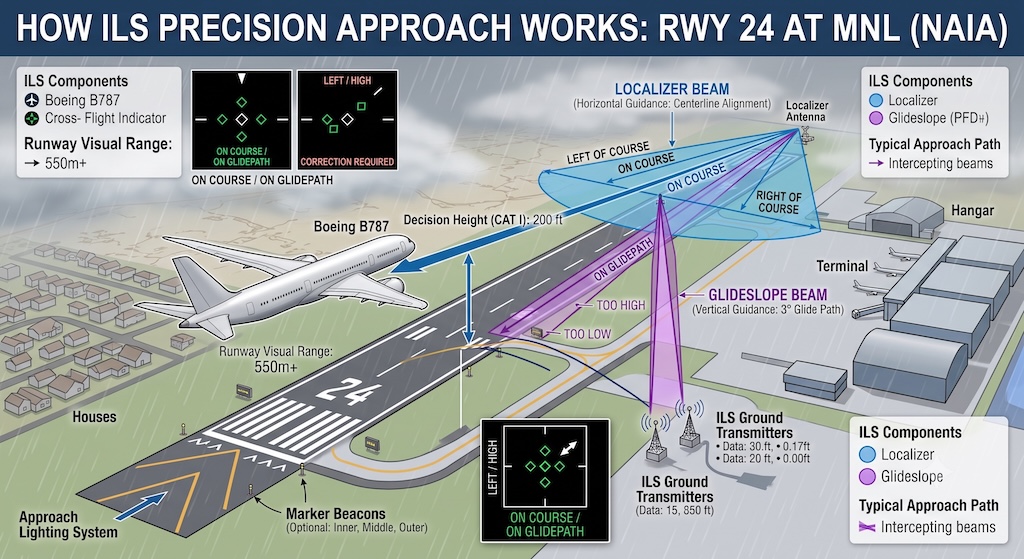
The primary reason behind the recent influx of diversions is not solely the severe weather, but a critical aviation notice currently in effect. Under official NOTAM B3881/26, effective from 03 August 2026 through 03 November 2026, the Category I Instrument Landing System for Runway 24 is completely unserviceable.
To understand why this specific outage creates chaos, one must look at Manila’s seasonal weather patterns. During the Philippines’ Southwest Monsoon (Habagat) season, prevailing winds blow steadily from the southwest. Because commercial airliners must land into the wind for aerodynamic safety, main runway operations shift almost exclusively to Runway 24 (the runway end near SLEX). Under normal circumstances, incoming aircraft follow precision radio beams down through rain and low clouds, but with the system offline, pilots are stripped of vertical radio guidance during peak monsoon season.
Without an operational ILS on Runway 24, pilots are forced to rely on non-precision approaches, such as RNAV or VOR/DME navigation. Under standard ILS CAT I procedures, an aircraft can safely descend down to a decision height of 200 feet above the ground and requires only 550 meters of horizontal visibility to complete a landing.
By contrast, non-precision approaches force pilots to adhere to much higher safety minimums. Flight crews must remain higher in the air, usually restricted to a minimum descent altitude between 400 and 600 feet, while horizontal visibility requirements jump significantly to between 1,500 and 2,400 meters. If a localized squall drops visibility over NAIA to 800 meters — a condition an active CAT I ILS easily manages — pilots flying a non-precision approach on Runway 24 are legally prohibited from landing and must immediately climb away.
Monsoon Hazards Beyond Visibility
Even when visibility temporarily stays above non-precision limits, tropical rainstorms introduce secondary hazards that make landing hazardous. Severe rain cells over Manila Bay frequently generate microbursts and violent low-level wind shear, causing rapid airspeed fluctuations that prompt immediate go-arounds during final approach.
In addition, intense downpours often overwhelm runway drainage systems, leaving standing water that creates a severe risk of hydroplaning upon touchdown. To compound matters, lightning red alerts freeze all ramp operations on the ground, leaving arriving aircraft with nowhere to park even if they manage to break through the clouds safely.
Until the Runway 24 ILS equipment at Manila is fully restored in November 2026, NAIA will remain exceptionally vulnerable to weather disruptions during heavy rain. When visibility drops below mandatory non-precision thresholds, diverting to an alternate airport remains the only legal and safe choice for flight crews.